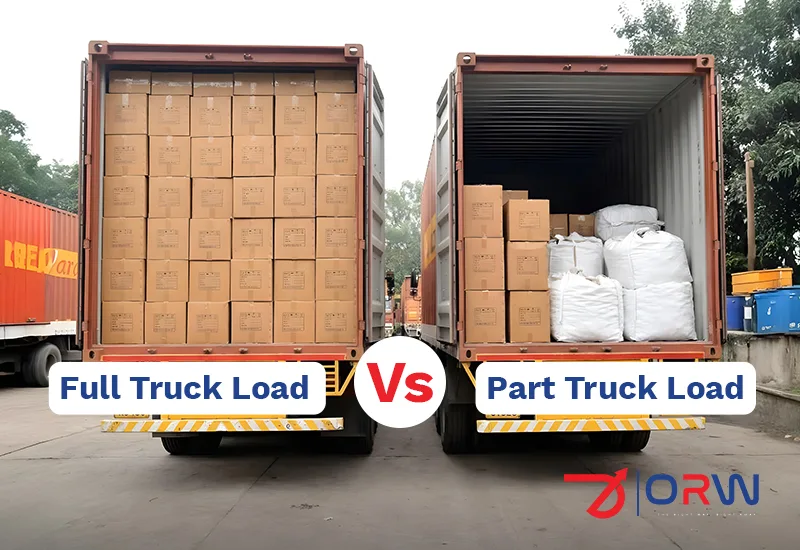
You’re standing at your warehouse, looking at pallets of goods that need to reach their destination. Now comes the big question – should you book an entire truck or share space with other shippers?
This decision between full truck load vs part truck load isn’t just about saving money. It affects delivery speed, cargo safety, and how smoothly your supply chain runs. Pick wrong and you’ll either waste money on empty truck space or deal with delays from multiple stops.
Let’s break down what actually matters when choosing between these two shipping methods.
What Exactly is Full Truck Load (FTL)?
Full truck load means you’re renting the entire truck for your cargo alone. The truck picks up from your location, drives straight to your destination, and unloads. Nobody else’s goods share that space.
Think of it like booking a private car versus taking a bus. With FTL, that truck is yours from start to finish.
Full truck load transportation services work when you have enough cargo to fill most of the truck – typically 10 or more pallets, or around 10,000 pounds. The exact amount depends on truck size, but the idea is simple: you’re using enough space that paying for the whole truck makes sense.
Why FTL Matters for Business Logistics?
Faster Delivery Times
Your truck goes directly from point A to point B. No stops to pick up other shipments. No detours to drop off someone else’s cargo. This direct route cuts transit time significantly.
Better Cargo Security
Your goods get loaded once and don’t get touched until they reach the destination. Less handling means less chance of damage. Plus, there’s no risk of your cargo getting mixed up with someone else’s shipment.
Cost Efficiency for Large Shipments
When you have substantial cargo, full truck load transportation services actually cost less per unit than shipping smaller quantities. You’re not paying per pallet – you’re paying for truck space, and you’re using all of it.
Simpler Tracking
One truck, one route, one delivery. Tracking becomes straightforward. You know exactly where your shipment is without worrying about which leg of a multi-stop journey it’s on.
Which Industries Should Choose FTL?
Manufacturing Companies
Factories moving raw materials or finished products in bulk quantities benefit hugely from FTL. When you’re shipping machinery parts, steel, chemicals, or large production runs, filling a truck isn’t hard.
Retail Chains
Big retail businesses restocking multiple stores or distribution centers often need FTL. Moving inventory for seasonal sales? FTL gets everything there faster.
E-commerce Warehouses
Large e-commerce operations shipping between fulfillment centers use FTL regularly. When you’re moving thousands of products at once, dedicated trucks make sense.
Construction Projects
Construction sites need building materials in bulk – cement, steel rods, tiles, pipes. FTL delivers everything at once without the hassle of coordinated smaller shipments.
Food and Beverage Distributors
Bulk food shipments, especially perishables, need the speed and temperature control that FTL provides. You can’t afford delays or multiple handling points with fresh produce.
What is Part Truck Load (PTL)?
Part truck load means you’re sharing truck space with other businesses. Your cargo occupies only part of the truck, and other shippers fill the remaining space.
It’s like carpooling for freight. Multiple customers split the truck, and everyone pays for just their portion of the space.
Part truck load transportation services work when you have less cargo – maybe 2-8 pallets or shipments under 10,000 pounds. You’re not filling an entire truck, so why pay for one?
Why PTL Makes Business Sense?
Lower Costs for Smaller Shipments
You only pay for the space your cargo actually uses. If you’re shipping 4 pallets, you don’t need to pay for the other 20 pallets worth of empty space.
More Shipping Flexibility
PTL gives smaller businesses access to professional trucking without needing truckload quantities. You can ship whenever you need to, not wait until you’ve accumulated enough cargo to justify FTL.
Better for Regular Small Shipments
Businesses with steady but moderate shipping volumes find PTL perfect. You maintain consistent delivery schedules without the pressure of filling entire trucks.
Reduced Environmental Impact
Sharing truck space means fewer trucks on the road overall. Multiple businesses consolidate into one truck instead of each running partially empty vehicles.
Industries That Benefit from PTL
Small to Medium Businesses
SMEs typically don’t generate truckload quantities regularly. Part truck load transportation services let them ship professionally without the bulk requirements.
Specialty Manufacturers
Companies making niche products with smaller production runs find PTL ideal. You’re not mass-producing, so you’re not mass-shipping either.
Wholesale Distributors
Wholesalers supplying smaller retailers often use PTL. Each retail customer doesn’t need a full truck, but together they fill one efficiently.
Startups and Online Sellers
New businesses testing markets or scaling up benefit from PTL’s flexibility. You ship what you sell without committing to full truckloads.
Seasonal Businesses
Companies with fluctuating demand use PTL during slower periods and might switch to FTL during peak seasons. This flexibility matches their business cycle.
Full Truck Load vs Part Truck Load: Key Differences
| Factor | Full Truck Load (FTL) | Part Truck Load (PTL) |
| Cargo Volume | 10+ pallets or 10,000+ lbs | 2-8 pallets or under 10,000 lbs |
| Transit Time | Faster – direct route | Slower – multiple stops |
| Cost Structure | Fixed price for full truck | Pay per pallet/weight |
| Handling | Loaded once, unloaded once | Multiple loading/unloading points |
| Damage Risk | Lower – minimal handling | Slightly higher – more handling |
| Flexibility | Less flexible – need full loads | More flexible – ship any amount |
| Best For | Large bulk shipments | Smaller, regular shipments |
| Delivery Type | Direct point-to-point | Hub-based consolidation |
| Tracking Complexity | Simple – one route | More complex – multiple routes |
| Ideal Timeline | Urgent, time-sensitive cargo | Standard delivery timelines |
What to Consider When Choosing Between FTL and PTL?
Calculate Your Cargo Volume
Measure how much you’re actually shipping. Got 12 pallets? FTL probably makes sense. Only 4 pallets? PTL might be a smarter choice.
Check Your Timeline
Need it there tomorrow? The FTL vs PTL difference in speed matters here. FTL’s direct route beats PTL’s multi-stop journey every time.
Think About Your Cargo’s Nature
Fragile items? Expensive goods? Temperature-sensitive products? FTL’s reduced handling protects these better. Durable, low-value items handle PTL’s multiple stops just fine.
Look at Shipping Frequency
Shipping weekly in moderate volumes? PTL builds a predictable routine. Shipping monthly in bulk? FTL might be your pattern. Match the service to your rhythm.
Consider Your Budget Reality
FTL costs more upfront but offers better per-unit pricing for large loads. PTL has lower initial costs but higher per-unit rates. Run the numbers based on actual cargo amounts.
Evaluate Delivery Points
Single destination? FTL goes direct. Multiple drop-offs along a route? PTL’s multi-stop nature might actually work in your favor with proper coordination.
Factor in Cargo Security Needs
High-value shipments benefit from FTL’s single handling. Standard goods handle PTL fine. Match security needs to service type.
Making the Smart Choice with Okara Roadways
Understanding full truck load vs part truck load options helps you optimize logistics spending. Neither option is “better” – they serve different business needs.
Okara Roadways offers both full truck load transportation services and part truck load transportation services across India. With over 300+ trucks and operations since 1986, we’ve moved everything from medicines to machinery.
Our drivers know the best routes. Our GPS tracking keeps you updated in real-time. Our maintenance schedules prevent delays. Whether you need dedicated FTL for bulk shipments or flexible PTL for smaller loads, we’ve handled it all.
At okara roadways we look at your cargo volume, destinations, and timeline to recommend the most cost-effective approach. Want to figure out which option fits your specific needs? Contact us today for customized freight solutions that match your business needs.
Okara Provide Route solution- delhi to mumbai , Gujarat to Chandigarh, Mumbai to Chandigarh, Punjab to Mumbai, Punjab to Gujarat More.