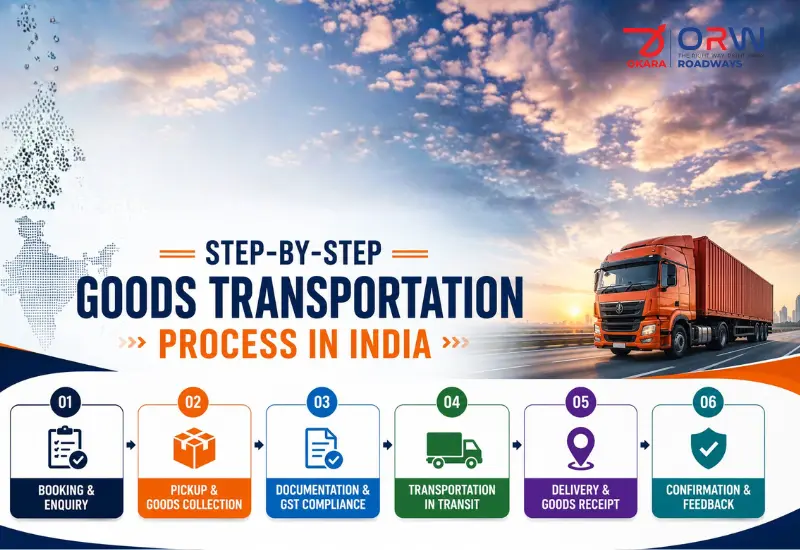
Most businesses interact with the goods transportation process at two points — when they hand over cargo and when it arrives. What happens in between is largely invisible, which is exactly why problems are hard to anticipate and losses are difficult to attribute when they occur.
Understanding how goods transportation works in India — step by step — gives you better visibility into where delays originate, what questions to ask your logistics partner, and how to set up shipments to reduce the chance of something going wrong. The logistics process in India involves more coordination than it looks like from the outside, and the quality of each step compounds into the reliability of the overall result. Okara Roadways manages freight transportation across all 36 Indian states and union territories, with FTL, PTL, and small-load Parchun services built for exactly the coordination challenges this guide covers.
Step 1: Order Booking and Shipment Planning
Every goods transportation process starts before the truck arrives. The booking stage involves more than just confirming a pickup date.
A well-handled booking captures the cargo details — weight, dimensions, commodity type, fragility — alongside the origin, destination, and delivery window. This information determines the vehicle type needed, the route, whether the cargo needs any special handling, and how it’s priced.
Shipment planning also involves checking e-way bill requirements, applicable state-specific permits, and any transport documentation required for the commodity and the route. Skipping this stage properly is what causes documentation delays at checkpoints mid-journey. Freight forwarding and transportation management start here — not at the loading dock.
Step 2: Pickup and Loading
Pickup timing matters more than most shippers realise. For time-sensitive cargo, a delayed pickup often propagates through the rest of the schedule.
At loading, cargo handling quality determines a lot of what happens downstream. Proper stacking, securing, and packaging-appropriate loading reduces movement damage significantly. Heavy items should go to the floor; fragile items should be isolated from load shift. Overloading reduces vehicle stability, increases tyre wear, and at its worst creates liability at weighbridge checkpoints.
Condition documentation at loading is worth building into the process: photographs and a written description of cargo condition at handover create clear records for any disputes at delivery. For road freight transportation, a signed lorry receipt (LR) or goods receipt note (GRN) is the primary document from this stage.
Step 3: Transportation and Transit
This is the longest and often least visible phase of the goods transportation process.
During transit, vehicles cover the primary route from origin to destination. In India, road freight moves on a network where route planning matters — not just for distance, but for road condition, checkpoint patterns, toll costs, and seasonal variations like monsoon-damaged roads.
Cargo transportation in India increasingly uses GPS-based shipment tracking that gives shippers real-time visibility into vehicle location. This is standard with digitally-operated carriers like Okara Roadways, whose fleet tracking allows both the shipper and receiver to monitor progress and anticipate actual arrival.
Delays during transit come from a few consistent sources: traffic, checkpoint documentation issues, vehicle breakdowns, and weather. Experienced carriers plan for these — alternative routes, documented cargo manifests to clear checkpoints quickly, vehicle maintenance schedules that reduce mid-route failures.
Step 4: Warehousing and Distribution (If Required)
Not all cargo moves directly from origin to final destination. For multi-stop deliveries, cross-state supply chain management, or situations where the receiving location isn’t ready at delivery time, intermediate warehousing is part of the logistics process in India.
A warehousing and distribution step typically involves unloading cargo at a hub, storing it in appropriate conditions, reloading onto secondary vehicles, and dispatching to multiple end destinations. This stage adds time and handling — each transfer point is an opportunity for damage or loss if the facility and processes aren’t managed properly.
For the Parchun category of loads — small retail consignments distributed to multiple last-point destinations — this intermediate stage is integral to how the service works. Freight movement from a manufacturer to fifty small retailers goes through consolidation and distribution rather than direct point-to-point.
Step 5: Last-Mile Delivery
Last-mile delivery is statistically the most expensive and operationally the most complex part of the logistics network — and the one the end customer experiences directly.
In Indian contexts, last-mile complexity comes from address systems that aren’t always standardised, access restrictions in commercial and residential areas, recipient availability, and the sheer density of deliveries needed in urban markets.
For B2B cargo — commercial deliveries to businesses, retailers, or manufacturing facilities — last-mile delivery is usually scheduled and coordinated in advance. For goods delivered to smaller retail outlets, the Parchun model aggregates multiple small deliveries into a single vehicle’s route, making distribution economically viable at small-consignment scale.
Carrier experience at this stage shows clearly in on-time delivery rates, damage rates, and the accuracy of delivery documentation.
Step 6: Tracking, Documentation, and Settlement
Settlement and documentation close the loop — the shipment isn’t complete until the paperwork is.
Delivery confirmation — a POD (proof of delivery) signed by the receiver — is the document that triggers payment terms and closes the shipment. Incomplete or missing PODs create disputes. A digital POD system, increasingly standard with organized logistics services in India, timestamps delivery and captures receiver confirmation in a way that’s hard to dispute.
Tracking data from GPS-connected vehicles provides a journey record — every route segment, timing, and checkpoint — that serves as a comprehensive record if questions arise about delays, route deviations, or condition at delivery.
Invoice reconciliation, any damage claims, and final settlement follow from this documentation. The carriers and shippers with clean documentation practices at every step resolve these quickly. Those without it spend weeks on disputes that could have been avoided.
Conclusion
The goods transportation process in India runs through six stages — booking, pickup, transit, warehousing, last-mile delivery, and documentation — and the reliability of each one affects the output of the whole. A delay at booking creates a cascade. A loading error shows up at delivery. A missing document slows a checkpoint.
Understanding how goods transportation works in India doesn’t just satisfy curiosity — it gives businesses the ability to choose better logistics partners, ask better questions at booking, and set up shipments to run more smoothly.
Okara Roadways provides end-to-end logistics solutions across India — FTL, PTL, and Parchun services with real-time tracking, digital documentation, and a network covering all 36 states. Visitokararoadways.net to enquire or book a shipment.
The process includes shipment booking, pickup, transit, warehousing (if required), last-mile delivery, and final documentation.
Most logistics companies provide GPS-based tracking, allowing you to monitor your shipment’s location in real time.
Common documents include the e-way bill, invoice, lorry receipt (LR), and proof of delivery (POD).
FTL uses an entire truck for one shipment, while PTL shares truck space with multiple consignments.
Correct loading helps prevent cargo damage, improves vehicle safety, and ensures smoother delivery operations.