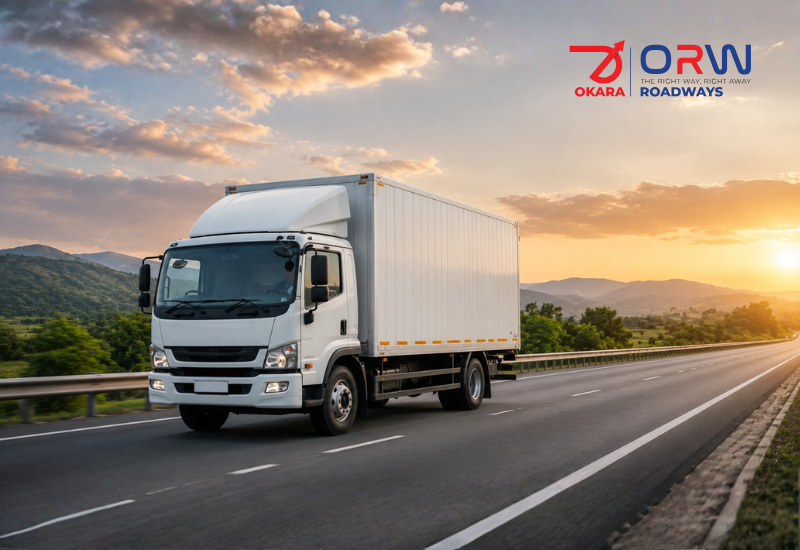
At a certain shipment volume, the question stops being “how do I ship this?” and becomes “is there a smarter way to structure this?” Large shipment transportation has a crossover point where consolidating cargo into a single truck — rather than booking multiple smaller loads — starts generating meaningful cost savings. That crossover is the FTL decision.
Full truck load shipping, FTL logistics, and dedicated truck shipping all describe the same core approach: booking the entire capacity of one truck for one shipment, one origin, one destination. The alternatives — part loads, consolidated freight — are cheaper per kilogram but come with longer transit times, more handling, and more exposure to damage and delay.
Okara Roadways operates a network of 75,000+ vehicles across all 36 states and union territories in India, handling FTL and PTL shipments with fully digital operations. For businesses evaluating cargo shipping solutions, bulk cargo transportation, and large shipment decisions, this guide covers when FTL makes sense and how to get the most out of it.
What Is Full Truck Load (FTL) Shipping?
Full truck load shipping means your cargo fills the entire truck. There are no co-loaded consignments, no intermediate stops to pick up or drop off other freight. The vehicle goes from your loading point to your delivery point without diversion.
In India, a standard FTL assignment uses trucks ranging from 9-tonne to 40-tonne capacity depending on the cargo type and route. Multi-axle vehicles handle heavy cargo transportation and the most demanding industrial loads; smaller trucks cover the mid-range of commercial cargo transport. The defining factor is always that the truck capacity — or a close match to it — is committed to a single shipment.
When Do Businesses Need FTL Shipping?
FTL makes sense when one or more of the following conditions apply.
Volume. When a shipment fills roughly 60–70% or more of a truck, the economics usually favour FTL over PTL. Below that threshold, part loads are typically more cost-effective.
Time sensitivity. Consolidated freight services run on shared schedules. FTL runs on yours. For time-critical deliveries — retail replenishment, just-in-time manufacturing inputs, or urgent bulk freight transportation — dedicated truck transport removes the scheduling uncertainty.
Fragility or sensitivity. Cargo that can’t tolerate multiple handling points — fragile goods, hazardous materials, temperature-sensitive products — moves more safely in a dedicated truck than through a consolidated network.
Security. High-value cargo benefits from reduced handling exposure. An FTL shipment with shipment tracking means fewer opportunities for loss or tampering than multi-handling freight.
Is FTL Shipping Cheaper for Large Shipments?
For large volumes, FTL is almost always cheaper on a per-unit or per-tonne basis than the equivalent in part loads or consolidated freight.
The math is straightforward. A truck booking from Delhi to Mumbai via FTL costs a fixed amount for the entire vehicle. Split the same cost across 20 tonnes of cargo and the per-tonne rate is substantially lower than booking 20 individual PTL consignments. The efficiency gain comes from eliminating consolidation charges, intermediate handling fees, and the premium that carriers charge for flexibility on smaller loads.
The cost advantage narrows as shipment size decreases — which is why the 60–70% capacity threshold matters. Below that, FTL often isn’t cheaper because you’re paying for unused truck space. Above it, you’re getting large volume shipping at a rate that consolidated freight can’t match.
There’s also a less obvious cost saving: damage reduction. Cargo that goes through fewer handling points has lower damage and shrinkage rates. For businesses that calculate total logistics cost rather than just freight cost, this matters.
Key Benefits of Full Truck Load Shipping
Direct routing — the truck doesn’t stop except for driver rest and fuel. Long distance cargo shipping via FTL moves faster than consolidated freight on the same routes.
Reduced handling — fewer touch points means fewer opportunities for damage, loss, or mishandling.
Predictable transit times — FTL schedules are specific to your shipment. Estimated arrival windows are tighter than consolidated freight, where delays at any co-loaded stop propagate across all consignments.
Simpler freight management — one truck, one contract, one tracking ID. Enterprise logistics teams working with high volumes often prefer FTL specifically because it simplifies the operational overhead.
Security — dedicated truck shipping keeps your cargo isolated from other consignments throughout transit.
How to Reduce Costs on Bulk Cargo Transportation
Even with FTL’s structural cost advantage, a few operational choices affect the final cost.
Maximise vehicle utilisation. The cost of a truck is fixed regardless of whether it carries 15 tonnes or 20 tonnes. Packing closer to the vehicle’s rated capacity brings the per-unit cost down.
Plan routes with backloads in mind. Logistics partners with large networks — like Okara Roadways across its pan India cargo services coverage — can often offer better rates on routes where they have high backload opportunities. A Delhi-to-Mumbai movement with a guaranteed backload gets priced differently than a one-way trip.
Commit to volume. Businesses with regular, predictable FTL needs can negotiate freight transportation services contracts at better rates. Logistics cost optimization at this level comes from volume commitment, not just route selection. Supply chain logistics contracts with defined volume commitments give the carrier planning certainty, which translates to pricing.
Consolidate dispatch windows. Shipping three times a week at partial capacity often costs more than shipping twice a week at full capacity. Inventory and warehouse to warehouse delivery planning affect FTL costs significantly.
Choosing the Right Logistics Partner
Large shipment transportation via FTL only delivers its cost benefits if the carrier has the network, fleet, and operational reliability to execute consistently.
The questions worth asking: Does the carrier cover your specific routes reliably for industrial cargo transportation — not just nominally? What tracking visibility do they provide? How do they handle claims or delays? Do they have experience with your cargo type?
Okara Roadways provides full truck load services across India with digital shipment tracking, a fleet covering FTL and PTL requirements, and an operations model built around truckload freight services for business clients. For enquiries, reach out at zoravar@okararoadways.net or call +91-85272-30566.
Conclusion
For large shipment transportation, FTL is typically the right answer once volume, timing, or cargo sensitivity crosses the relevant threshold. The per-unit economics improve as truck utilisation approaches capacity, the transit predictability is higher than consolidated options, and the handling reduction delivers secondary savings that don’t appear in the headline freight rate.
Understanding where your shipments sit relative to that threshold — and choosing a logistics partner with the network to execute — is the practical work of business shipping solutions at scale.
FTL (Full Truck Load) uses an entire truck for a single shipment, while PTL (Part Truck Load) combines cargo from multiple shippers in the same vehicle.
FTL is generally more economical when your cargo occupies around 60–70% or more of a truck’s capacity.
Yes. Since there are no additional pickup or delivery stops, FTL shipments usually reach their destination faster and with fewer delays.
Large-volume shipments, high-value goods, fragile products, industrial materials, and time-sensitive cargo are commonly transported through FTL services.
Maximizing truck capacity, consolidating dispatch schedules, planning shipments in advance, and partnering with an experienced logistics provider can help reduce transportation costs.