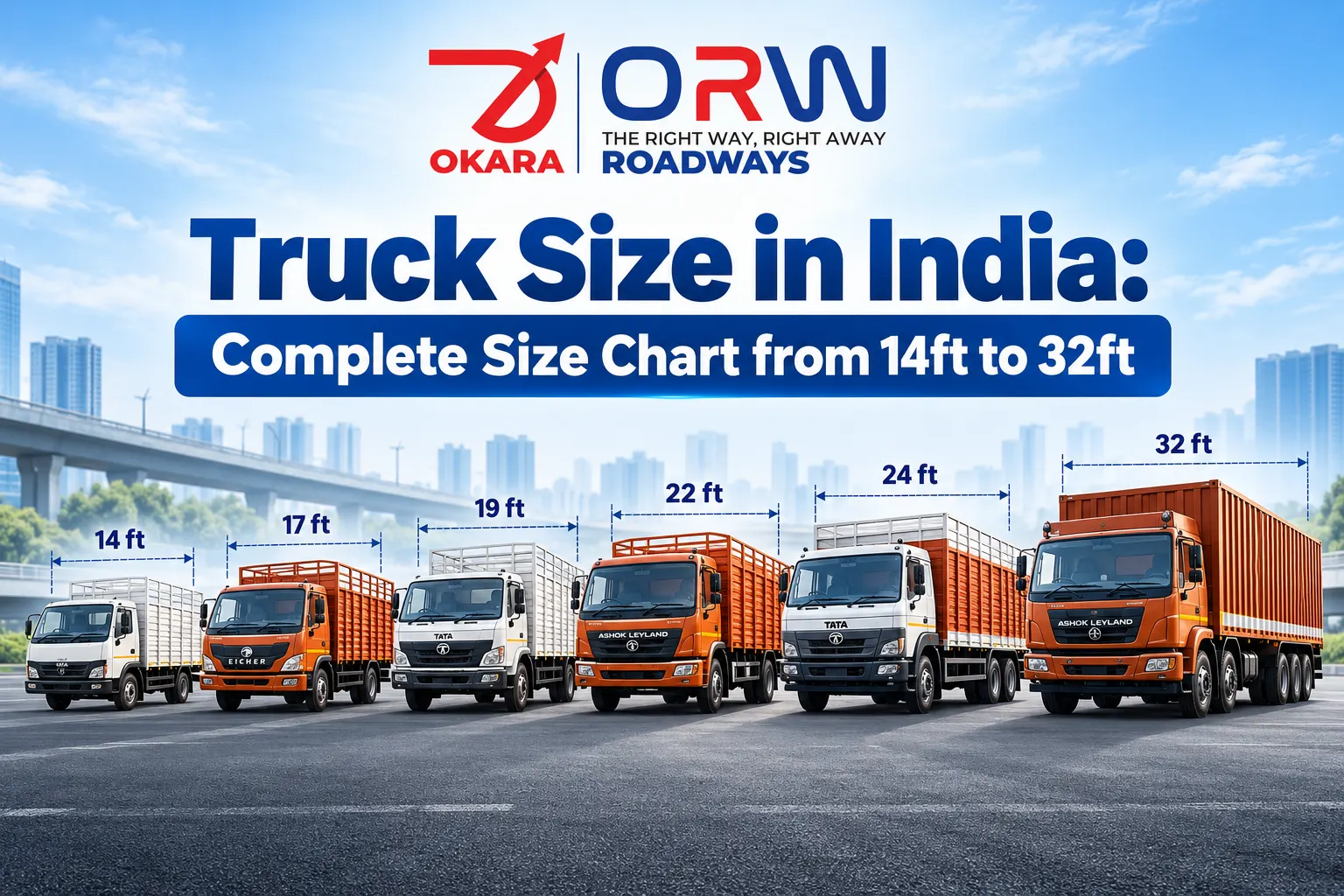
Choosing the right truck size in India sounds simple until a “19 ft” truck rolls up and your goods refuse to cooperate. That number tells you one thing. Just one. Cargo-body length dictates the physical shell. Usable space defines actual capacity. Permissible payload restricts legal weight limits. Axle configuration dictates how weight travels safely across highways. Picking the wrong setup causes loading delays. You waste colossal pockets of space. Overweight consignments get stuck endlessly at highway checkpoints. Understanding the distinct truck types in India saves money. We will break down common 14 to 32 ft vehicle categories. Know exactly what to measure. Stop guessing.
Truck Size in India: 14-32 ft Chart
| Truck category | Body dimensions (ft) | Indicative payload | Common cargo |
|---|---|---|---|
| 14 ft | 14 × 6 × 6 | 3.5 – 4 Tonnes | Packaged goods |
| 17 ft | 17 × 6.5 × 6.5 | 4 – 5 Tonnes | Commercial freight |
| 19 ft | 19 × 7 × 7 | 5.5 – 7 Tonnes | Distribution cargo |
| 20 ft container | 20 × 8 × 8 | 6 – 8 Tonnes | Enclosed freight |
| 22 ft | 22 × 8 × 8 | 7 – 9 Tonnes | Industrial goods |
| 24 ft | 24 × 8 × 8 | 8 – 10 Tonnes | Longer consignments |
| 32 ft SXL | 32 × 8 × 8 | 7 – 8 Tonnes | Bulky, lighter goods |
| 32 ft MXL | 32 × 8 × 8 | 14 – 18 Tonnes | Heavier bulk freight |
These numbers offer a starting baseline. Advertised sizes and actual internal measurements rarely agree perfectly. Walls have physical thickness. Hardware steals room. A specific truck dimensions in India check prevents bad surprises. An indicative payload is just a loose average. The true truck loading capacity in India depends entirely on the chassis and axle setup. The registered vehicle limits dictate everything. Two trucks of identical length carry wildly different weights easily. A longer floor often just provides a gigantic box of empty air. Determining the actual container truck size in India requires tape measures. You cannot just read a sticker. You must know the Truck Size in India parameters deeply.
How Truck Dimensions Work
Body Length vs Vehicle Length
Advertised dimensions usually refer to the cargo body. The overall vehicle includes the driver cabin and chassis. This distinction matters immensely. Warehouse access depends on total bumper-to-bumper length. Turning space requires looking at the entire footprint.
Internal vs External Space
The outside tape measure lies. Floor width, internal height, and wall thickness chew into usable loading length. Standard pallets require specific floor grids. Bulky packaging destroys mathematical models. Knowing real truck dimensions in India keeps shipments moving.
Door and Height Clearance
Theoretical volume means nothing if the goods cannot pass through the back door. The vehicle height, the cargo-body height, and the actual loading entrance represent distinctly different measurements. Checking the container truck height stops damaged goods. A crate measuring 7.5 ft high fits beautifully inside an 8 ft ceiling. It still fails to pass through a shorter door frame. Master your Truck Size in India rules here.
Trucks from 14-19 ft
14 Feet Truck Capacity
This nimble vehicle dominates congested streets. Common dimensions offer around 14 feet of length. The standard 14 feet truck capacity handles 3.5 to 4 tonnes. Chassis models alter these numbers slightly. This compact option moves standard cartons easily. Textiles and smaller industrial consignments fit beautifully.
17 ft Truck Size
Step up slightly in physical floor length. Typical payloads stretch to roughly 4 or 5 tonnes. The 17 ft truck size proves valuable for commercial goods that cannot be stacked safely. Fragile electronics or oversized furniture need direct floor contact. It holds exactly what a standard 14 feet truck capacity limits. You gain floor space without paying for a gigantic hauler.
19 ft Truck Size
This body configuration supports general commercial freight beautifully. A reliable 19 ft truck size easily handles longer building materials. You gain a serious floor-space advantage over the shorter models. The 17 ft truck size simply cannot hold extended pipes. Choosing this vehicle just because a load weighs more is a mistake. Payload ratings dictate the rules. A specialized shorter chassis might hold the exact same weight legally. Check the manufacturer plate.
Trucks from 20-24 ft
20 ft Container Truck
Enclosed cargo requires this standard box. Goods needing protection from rain and dust demand a 20 ft container truck. An ordinary road-freight body differs wildly from a standard ISO shipping container. Road bodies use thinner walls. Authentic ISO marine containers handle brutal stacking pressures. Do not confuse them. A heavy forklift might punch right through a lightweight road container floor.
22 ft Truck Size
Warehouse stock movement flows smoothly with this option. The 22 ft truck size handles regional distribution cargo flawlessly. You face a strict trade-off here. Available physical space constantly fights the actual weight limit.
24 ft Truck Size
Longer vehicle bodies accommodate specialized packaged loads. Upgrading to a 24 ft truck size provides extra floor area. With equal width, it offers roughly 9.1% more length-based space than a 22 ft truck size floor. Extra space does not equal extra payload. You just get more room to spread lighter items.
32 ft Container Trucks
Long-distance freight relies heavily on these colossal machines. When evaluating the correct container truck size in India, many companies default to this huge box. Figuring out your Truck Size in India parameters here requires math.
32 ft Truck Size
General use includes high-volume distribution and bulk movement. A standard 32 ft truck size interior creates a giant void. For a hypothetical clear interior of 32 by 8 by 8 ft, the volume equals exactly 2,048 CFT.
32 ft MXL vs SXL
| Comparison | SXL | MXL |
|---|---|---|
| Cargo body length | Commonly 32 ft | Commonly 32 ft |
| Indicative payload | Often 7-8 tonnes | Commonly 14-18 tonnes |
| Rear axle configuration | Single | Multiple |
| Freight suitability | Bulky and lighter cargo | Denser, heavier consignments |
These are booking industry examples. A 12-tonne load easily exceeds a typical single-axle limit. Comparing 32 ft MXL vs SXL setups prevents destroyed suspensions. That exact same 12-tonne load perfectly suits a multi-axle vehicle. Same length. Different bones underneath.
Container Truck Height
Do not ignore the metal roof. Ordinary bodies offer standard clearance. Specialized high-cube bodies offer distinctly taller internal space. A taller container truck height carries risks on rural routes. Low overhead obstructions cause accidents. Extra height does not increase permissible weight.
Payload and Cargo Volume
GVW vs Payload
The registered vehicle weight dictates the rules. The unladen weight measures the completely empty truck. The permissible cargo load is the difference between them. Checking the official RC reveals the true truck loading capacity in India.
Volume in CFT and CBM
A clear 32 ft truck size measuring exactly 32 × 8 × 8 ft yields 2,048 CFT. Calculated geometric capacity differs from practical loading space. Irregular goods leave huge air gaps. Converting to CBM provides metric clarity for international shipments.
Weight Distribution
Total weight means little if placed badly. A 19 ft truck size might hold the legal weight limit entirely. Pushing that entire load against the front nose ruins steering control. Strict axle loading limits demand a perfectly even spread.
Types of Trucks
Types of Trucks in India
Commercial vehicles fall into distinct LCV, MCV, and HCV classifications. Body length and vehicle weight category describe different aspects. A visibly long truck does not automatically qualify to be a heavy truck. Weight classes define true mechanical capability.
Open vs Closed Bodies
A closed 20 ft container truck offers weather protection. Open bodies provide fast loading access for heavy machinery. The correct transport truck depends on your goods. Pick the structural style matching your commodities perfectly.
Special-Purpose Vehicles
Standard metal boxes simply cannot haul everything you throw at them. Open flatbeds easily manage those awkwardly wide loads that stubborn warehouse doors reject. Refrigerated units keep sensitive perishables freezing cold during blistering summer traffic jams. Taking a moment to study the specialized types of trucks in India saves you from renting a generic vehicle for a highly specific job.
Choose Your Truck
Finding the right container truck size in India requires following a logical path. Knowing the specific types of trucks in India prevents guessing. Your overall Truck Size in India strategy must rely on hard measurements.
Truck Selection Flow
Measure the Packed Cargo
|
v
Calculate Total Weight
|
v
Check Floor Space and Volume
|
v
Select Open or Closed Body
|
v
Verify Payload and Axle Limits
|
v
Check Route and Loading Access
|
v
Choose the Suitable Truck
Assess the exact physical dimensions. Calculate the total combined mass. Determine how much bare floor area is strictly necessary. Pick a roof and body type. Confirm the legal mechanical weight capacities. Check the final destination delivery environment. Choose the suitable truck.
Cargo-Based Examples
Lightweight but bulky cartons require more space than payload. A 32 ft MXL vs SXL choice is simple. Pick the single axle.
Dense industrial components require a higher rated carrying capacity. A standard 14 feet truck capacity will fail. A heavy-duty 17 ft truck size serves this density best.
Long, non-stackable packages need floor length and door clearance. A closed 24 ft truck size traps you if a crane is required. Pick an open flatbed.
Route and Loading Checks
Road and Entry Limits
Strict neighborhood access restrictions exist everywhere. Misjudging the container truck height ruins bridges. Understanding your physical truck dimensions in India keeps goods safe. Measure the actual destination gate. Basic vehicle manoeuvring takes serious physical space.
Permissible Vehicle Weight
GVW and axle ratings must be checked against specific vehicle documents. Trusting an online chart for exact truck loading capacity in India causes severe legal problems. The local transport inspector reads the official registration paper.
Before Dispatch
Packing dimensions dictate everything. Match the truck bed directly to the exact loading-bay height. Sending a 20 ft container truck without a receiving forklift creates chaos. A 22 ft truck size is useless if the warehouse cannot unload it. The cheapest quoted vehicle becomes brutally expensive when a failed delivery happens.
Why Choose Okara Roadways
Finding the right transport truck stops logistical nightmares instantly. Okara Roadways delivers highly customized transport options across the nation. We offer FTL for dedicated consignments and PTL for smaller shared-space loads. Parchun handles retail parcels effortlessly.
Our published company-owned fleet, exceeding 300 trucks, keeps supply chains moving. We match your specific payload to the optimal floor space naturally. Our team understands the distinct types of trucks available. Stop struggling with confusing transport measurements. Let our seasoned professionals manage your freight securely.
Conclusion
Selecting the perfect Truck Size in India prevents expensive transit failures. Always evaluate actual cargo dimensions, permissible payload, body configuration, and route conditions. A slightly longer truck means nothing if the axle cannot support the weight. Make intelligent transport decisions based on hard numbers. Okara Roadways provides the transportation expertise needed to move your goods safely. Partner with us today.
Acronyms Used
| Acronym | Full form |
|---|---|
| SXL | Single Axle |
| MXL | Multi Axle |
| GVW | Gross Vehicle Weight |
| RC | Registration Certificate |
| LCV | Light Commercial Vehicle |
| MCV | Medium Commercial Vehicle |
| HCV | Heavy Commercial Vehicle |
| FTL | Full Truck Load |
| PTL | Part Truck Load |
| CFT | Cubic Feet |
| CBM | Cubic Metres |
| ISO | International Organization for Standardization |
FAQs
1. What is the 14 feet truck capacity in India?
A 14 ft truck may carry roughly 2–4 tonnes, depending on its model and body. For accurate truck loading capacity in India, check the specific vehicle’s registered payload.
2. How do 17 ft and 19 ft truck dimensions in India compare?
A typical 17 ft truck size is around 17 × 6–7 × 7 ft, while a 19 ft truck size is around 19 × 6.5–7 × 6–7 ft. Actual internal dimensions vary.
3. What is the difference between 32 ft MXL vs SXL?
For a similar 32 ft truck size, SXL typically carries 7–9 tonnes, while MXL carries roughly 14–18 tonnes. The specific vehicle’s axle configuration and registered capacity determine its limit.
4. What is the container truck height of a 20 ft container truck?
The cargo body is commonly around 7–8 ft high, depending on its build. Check internal height, rear-door clearance, and total vehicle height before loading tall goods.
5. How do I choose among the types of trucks in India?
Match cargo weight and packed dimensions with the transport truck’s rated payload and usable space. Check body type, route access, and loading requirements before booking.