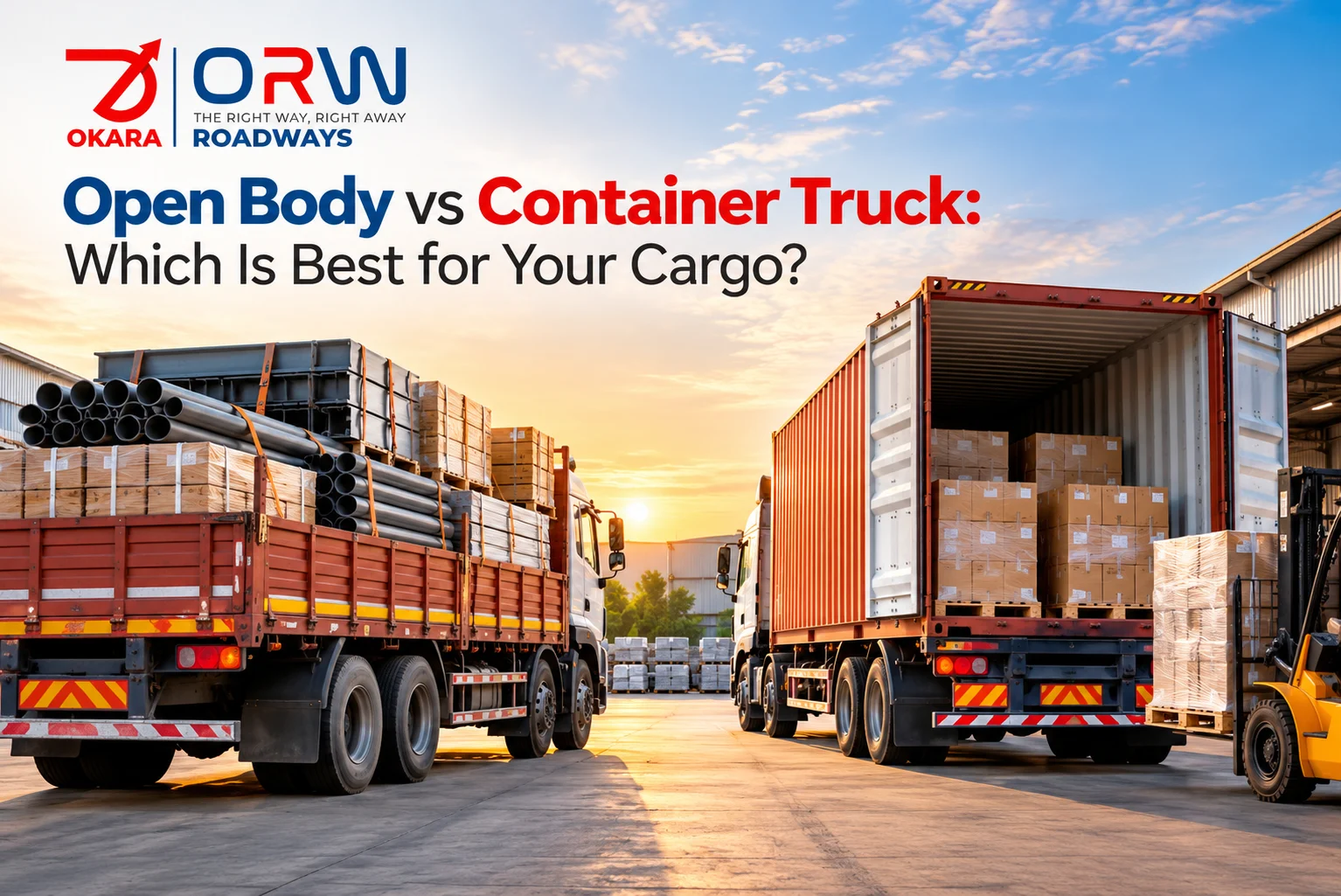
The open body vs container truck decision looks simple until a consignment arrives wet, shifted or short. Open body trucks load fast and carry almost anything, but they leave goods exposed. A container is a closed body truck that protects cargo from rain, dust and theft, but it costs more and can’t take oversized loads. Which one is right depends on what you ship, how far, and how much weather protection for goods you actually need.
Choosing the right truck for goods affects cargo safety during transit, truck freight charges and loading time, whether you book a full truck load (FTL) or a part truck load (PTL). Okara Roadways runs FTL, PTL and Parchun road freight services across all 36 Indian states and union territories, with real-time tracking and digital POD, and matching the vehicle to the cargo is the first decision on every booking. This guide compares the two main truck types for logistics so you can make that call with confidence.
What Is an Open Body Truck?
An open body truck has a cargo bed with no roof. Some have fixed or drop-down side walls, others are completely flat. Goods are secured with ropes, chains or straps, and a tarpaulin covered truck setup is used when rain or dust is a concern.
An open body truck for cargo suits loads that are bulky, heavy or awkward: steel, pipes, bricks, sand, construction material and machinery. Loading from the top and sides with a crane or forklift is easy, and there’s no door frame to limit height or width, within legal limits.
Open body truck capacity in India varies widely. Light and medium trucks carry roughly 1 to 7 tonnes. Six-wheelers carry around 9 to 10 tonnes, and 10 to 12-wheelers roughly 16 to 25 tonnes, with bed lengths from about 14 to 24 feet or more. Exact payload depends on axle configuration and permits.
The trade-off is exposure. Rain, sun and dust reach the load, a tarpaulin gives only partial protection, and visible cargo is easier to target.
What Is a Container Truck?
A container truck carries a fully enclosed steel box on its chassis, closed with lockable doors. Cargo is protected on all sides. The two common formats are 20 ft and 32 ft container trucks.
On container truck size and dimensions, a 20 ft container is roughly 20 ft long, 8 ft wide and 8 ft high externally. A 32 ft container is the same cross-section but longer. A 20 ft truck carries around 7 to 9 tonnes, a single-axle 32 ft is in a similar range, and multi-axle 32 ft versions carry more, roughly 14 to 20 tonnes, subject to permits.
A container truck for transport is the standard for FMCG goods transportation, electronics, appliances, textiles and packaged food. The doors can be sealed, which gives genuine goods theft protection, and the closed box keeps moisture out through monsoon routes.
The limits are the door opening, which rules out oversized cargo, and loading access only from the rear or side. The container’s own weight also takes a share of the permitted gross weight.
Open Body vs Container Truck: Key Differences
The difference between open body and container truck comes down to protection versus flexibility.
| Feature | Open Body Truck | Container Truck |
|---|---|---|
| Weather protection | Tarpaulin only, partial | Full enclosure |
| Theft protection | Low | High, lockable and sealable |
| Best cargo | Bulky, heavy, oversized | Packaged, fragile, high-value |
| Loading and unloading ease | Easy from top and sides | Rear or side doors only |
| Size limits | Flexible within legal rules | Fixed internal dimensions |
| Truck freight charges | Generally lower | Generally higher |
| Typical sizes | 14 to 24+ ft beds | 20 ft and 32 ft |
Neither is better in general. Each wins on the cargo it was built for.
Which Truck Is Best for Different Types of Goods?
There is no single best truck for cargo transport. The best choice depends on the goods.
| Goods | Better Choice | Why |
|---|---|---|
| Steel, pipes, structural material | Open body | Length and weight, crane loading |
| Heavy machinery transport | Open body or trailer | Exceeds container door limits |
| Bricks, sand, aggregate | Open body | Bulk loads, low value, easy unloading |
| FMCG goods | Container | Clean, dry, sealable |
| Electronics and appliances | Container | Theft and moisture risk |
| Textiles and garments | Container | Water damage and dust |
| Furniture | Container | Scratches and weather |
| Short-haul produce | Open body with tarpaulin | Ventilation, quick loading |
Cold-chain goods such as dairy or vaccines need a refrigerated vehicle, which is a different category from either of these.
How to Choose the Right Truck for Goods Transport
A short checklist covers most decisions.
Start with weather sensitivity. If water, dust or sun can damage the cargo, a container is the safer choice. If it can’t, an open body truck for cargo saves money.
Check size and weight against the vehicle. Measure the largest piece. If it won’t pass through the container door, the decision is made for you.
Weigh theft risk and value. High-value, easily resold goods belong behind a sealed door.
Consider the route and season. Long hauls through monsoon corridors favour a container. Short, dry-season runs with rugged cargo suit open body.
Look at loading facilities at both ends. A crane or forklift suits open body loading. A loading dock suits a container.
Think about load size. For a part truck load, closed vehicles are usual because several consignments share the space and need protection. A full truck load gives you the freedom to pick either.
Compare freight charges with claim costs. The cheaper truck isn’t cheaper if goods arrive damaged. Choosing the right truck for goods means counting the cost of damage, not just the freight rate.
Okara Roadways advises on vehicle matching at booking, and both vehicle types run with real-time tracking and digital proof of delivery.
Conclusion
The open body vs container truck choice is a cargo question, not a preference. Open body wins on bulky, heavy and oversized loads and on lower freight charges. Container wins on protection, security and clean delivery of packaged goods. Knowing the difference between open body and container truck, and the best truck for cargo transport for your specific goods, avoids both damage claims and overspending.
For road freight services with the right vehicle for your consignment, visit okararoadways.net to book FTL, PTL or Parchun loads.
FAQs
1. What is the difference between an open body and a container truck?
An open body truck has an exposed cargo bed, while a container truck has an enclosed body that protects goods from rain, dust, and theft.
2. Which is better for cargo transport: an open body or a container truck?
Open body trucks suit heavy, bulky, and oversized goods, while container trucks are better for packaged, fragile, and high-value cargo requiring protection.
3. What goods are suitable for an open body truck?
An open body truck for cargo is ideal for steel, pipes, bricks, sand, construction materials, and machinery that require flexible loading access.
4. Is a container truck better for long-distance transport?
A container truck is often better for long-distance transport when goods need protection from weather, dust, and theft, especially during monsoon travel.
5. How do I choose the right truck for goods transport?
Consider cargo size, weight, value, weather sensitivity, loading facilities, route, and freight charges before selecting the best truck for cargo transport.